Table of Contents
ToggleThe AI Revolution of 2026: 5 Major Trends Transforming Technology, Work, and Digital Life
Discover the AI Revolution of 2026, including on-device AI, AI agents, smart search, digital privacy, and future career skills. Learn how artificial intelligence is reshaping technology and everyday life.
Introduction: Artificial Intelligence Is Now Part of Everyday Life
Artificial Intelligence (AI) in 2026 is no longer a futuristic concept. It is now deeply integrated into smartphones, search engines, workplaces, and digital services. From personalized recommendations to automated workflows, AI has become the foundation of modern technology.
Today, users don’t just use AI tools — they interact with AI-powered systems every time they browse the web, shop online, or manage daily tasks. Understanding these changes is essential for businesses, digital creators, and tech-focused platforms like digitting.site
Here are the five major AI trends in 2026 that are shaping the future of technology and digital life.
1. On-Device AI: Faster Performance and Better Privacy
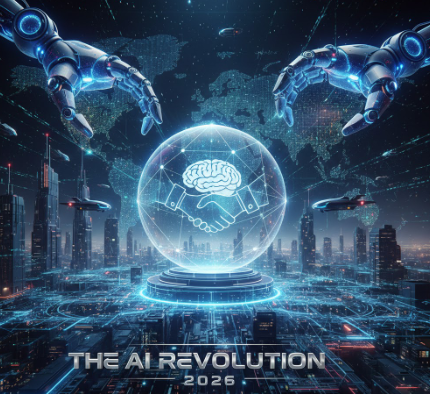
AI Revulution. One of the biggest advancements in artificial intelligence technology is the shift from cloud AI to on-device AI processing.
Faster AI Processing
Modern smartphones and laptops now include AI Neural Engines that handle tasks locally. This means:
-
- Real-time voice translation
-
- Instant photo and video enhancement
-
- Smart typing suggestions
-
- Noise cancellation during calls
All of this happens without delays caused by cloud communication.
Improved Data Privacy
Since data stays on your device:
-
- Personal photos are not uploaded unnecessarily
-
- Voice recordings remain local
-
- User behavior is less exposed to external servers
This makes AI privacy and security a major advantage in 2026.
AI Without Internet
Even offline, users can now access AI features like:
-
- Language translation
-
- Smart editing tools
-
- Writing assistance
On-device AI is turning personal devices into independent AI systems.
2. The Evolution of Search Engines and Digital Marketing
AI has transformed how people search online and how businesses reach customers.
AI-Powered Semantic Search
Search engines in 2026 focus on search intent, not just keywords. Instead of short phrases, users ask natural questions, and AI understands context.
Google now prioritizes E-E-A-T (Experience, Expertise, Authoritativeness, Trust). This means high-quality, informative content performs better than keyword-stuffed pages.
For websites like digitting.site, providing expert-level tech insights improves search rankings.
Predictive Digital Marketing
AI analyzes user behavior to predict needs before searches happen. Brands use AI tools to:
-
- Suggest products based on habits
-
- Optimize ad timing
-
- Personalize shopping experiences
This makes digital marketing smarter and more efficient.
3. AI Agents: From Assistants to Autonomous Systems
In 2026, AI has evolved from passive assistants into AI agents capable of completing complex tasks.
Automated Daily Tasks
Users can now ask AI to:
-
- Book flights and hotels
-
- Schedule meetings
-
- Compare prices
-
- Manage subscriptions
AI agents handle multi-step actions without constant human input.
AI in Professional Workflows
In workplaces, AI agents:
-
- Convert meetings into task lists
-
- Analyze large data sets
-
- Generate reports
-
- Track project deadlines
This improves productivity and reduces repetitive work.
AI is becoming a digital co-worker, not just a tool.
4. AI Ethics, Deepfakes, and Digital Trust
As AI-generated content becomes more realistic, trust and regulation are major topics in 2026.
AI Content Identification
Many platforms now require:
-
- Digital watermarks
-
- AI-origin metadata
-
- Creator verification
This helps fight misinformation and deepfake content.
Digital Identity Protection
Governments are introducing laws to protect:
-
- Facial data
-
- Voice samples
-
- Biometric information
AI ethics is now a core part of technology development.
5. Future-Proof Careers: AI Skills Are Essential
AI is reshaping the job market, but the future belongs to people who work with AI.
Prompt Engineering and AI Literacy
Knowing how to communicate effectively with AI tools is becoming a fundamental professional skill.
Human Creativity Still Matters
AI excels at automation and data processing, but humans lead in:
-
- Creativity
-
- Strategy
-
- Emotional intelligence
-
- Decision-making
The workforce of 2026 is built on human + AI collaboration.
Conclusion: The AI Future Is Already Here
The AI revolution of 2026 is transforming:
-
- Personal devices
-
- Online search
-
- Digital marketing
-
- Professional workflows
-
- Career development
Artificial Intelligence is now the backbone of the digital economy. For technology-focused platforms like digitting.site, publishing insightful and authoritative AI content builds trust with readers and aligns with modern search engine standards.
The future of technology is not about avoiding AI — it’s about understanding it and using it effectively.